The Wagashi Diet
Dear Reader,
Have you been enjoying your summer thus far? Or whichever season that now belongs to your part of the world? I must admit, and I’m terribly sorry, that I have been slightly—or quite a lot actually—distracted as of late. It’s no excuse to be derelict in my weekly blog writing, I know, and I apologize profusely! Please forgive me. It’s just that, well, you see… ahem, have you ever been to Japan? Have you ever eaten a matcha parfait?! And not just any matcha parfait, but one in Kyoto, in Gion Kyoto? If you have, then perhaps you can excuse my weak-willed writing (or lack thereof) this past month and accept my humble apologies, knowing full well that there truly is nothing better on earth than eating an exquisite matcha partfait in Gion-Kyoto! And what’s more?! I have been altogether swept up by the Wagashi Diet!
All joking aside, the above sentiments are not entirely in jest! I do truly love wagashi, Japanese sweets, and appreciating them and the cultural milieu in which they are steeped actually can be a kind of satori, an enlightening experience! And I have indeed been eating more of a “wagashi diet” while visiting family and friends in Japan this summer than I would like to admit. Of course I ate many other kinds of delicious Japanese foods too: soba, tempura, sushi, takoyaki, somen, oden, yuba, namafu, udon, onigiri, dashimaki tamago, gomadofu, etc. to name a few… If for no other reason, visit Japan for the food. It is absolutely worth it.
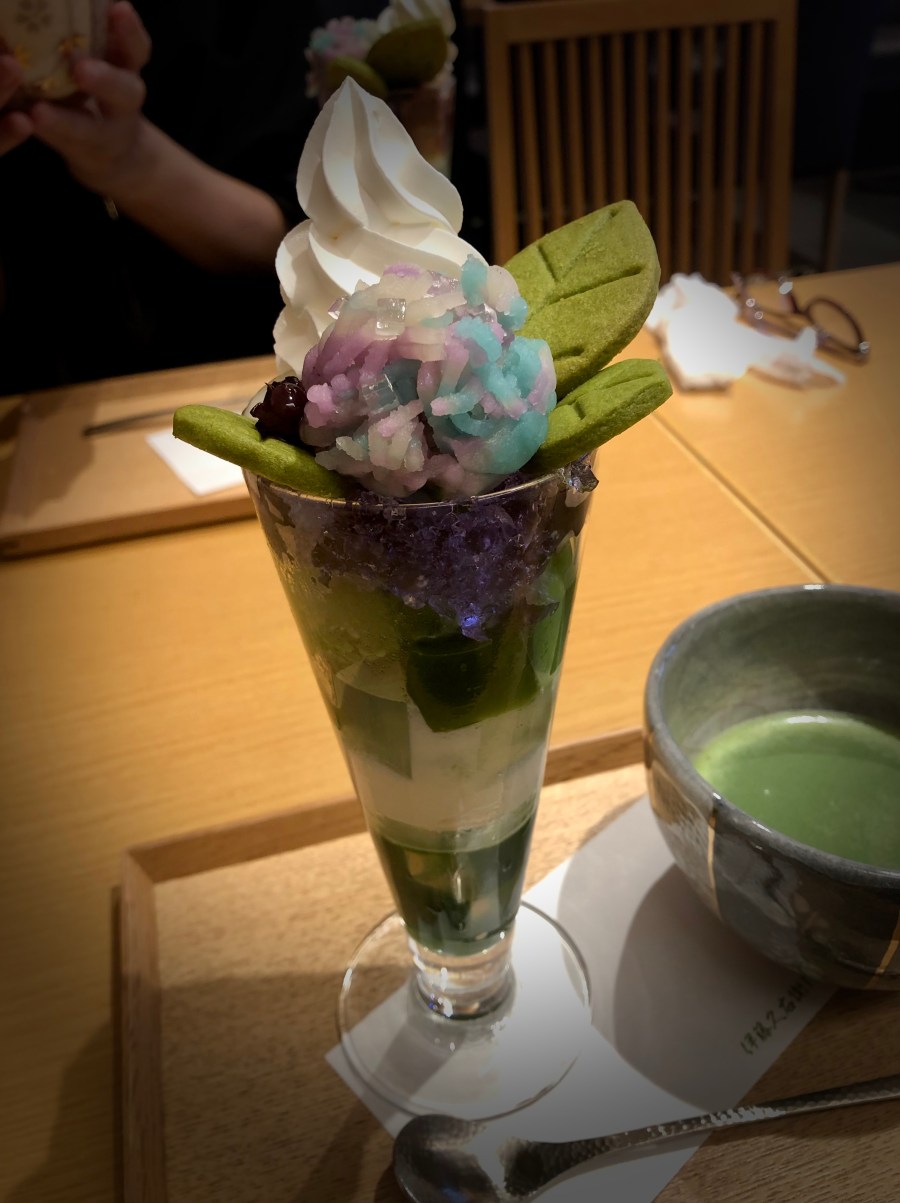
To be even a little more serious and precise, matcha parfait is not wagashi, which should be defined as traditional Japanese sweets, but is rather a Japanese-style parfait. From where does the parfait originate?! I haven’t the slightest clue, but it is from the Japanese lens, a “Western dessert.” For convenience, I have rather erroneously and sacrilegiously lumped together all sweets in Japan as wagashi! 😱 True wagashi will be seasonal and is typically paired with a cup of tea or matcha (the tea which you can see to the right of my parfait). In the photo the round, purple, blue, and white ball on top of the parfait is the actual wagashi, whereas the rest are…. parfait ingredients? Is wagashi piled on top of a parfait still wagashi? That is a discussion for another time!
This particular purple, blue, and white wagashi sitting atop my parfait is designed after hydrangea flowers which blossom abundantly during the rainy season in June, and therefore the parfait I had was a seasonal speciality, in keeping with the true nature of wagashi. The hydrangea wagashi, its colors, textures, and flavors, together with matcha, invokes the soul of the flower. We experience delicate sweetness and slightly bitter green leaves; the cool, light breeze and sound of soft rain surrounds us. We sense the damp earth blossoming into a riot of purples and pinks, blues and greens, and yellows.
Four years ago, in the month of June, I wrote of following line:
When we dance the mountains sing inside us and we bloom into a riot of wild flowers.
After practicing dance in the Kyoto countryside with lush green mountains in view, I enjoyed eating hydrangea wagashi together with our small group. It was satori—we truly are the mountains, the wind and flowers, the soft falling rain. We sing, and we are sung.
Shall I forgo my “wagashi diet” in the name of good health? Perhaps not!😁
Wishing you respite from distraction and busyness. I wish you the abundant blessings of the season. I wish you beauty. May you have an appetite for it all.
Yours truly,
Michiru Adrienne
p.s. My blog posts will resume on a more-or-less weekly basis from now on. Thank you for reading!
 Michiru Adrienne