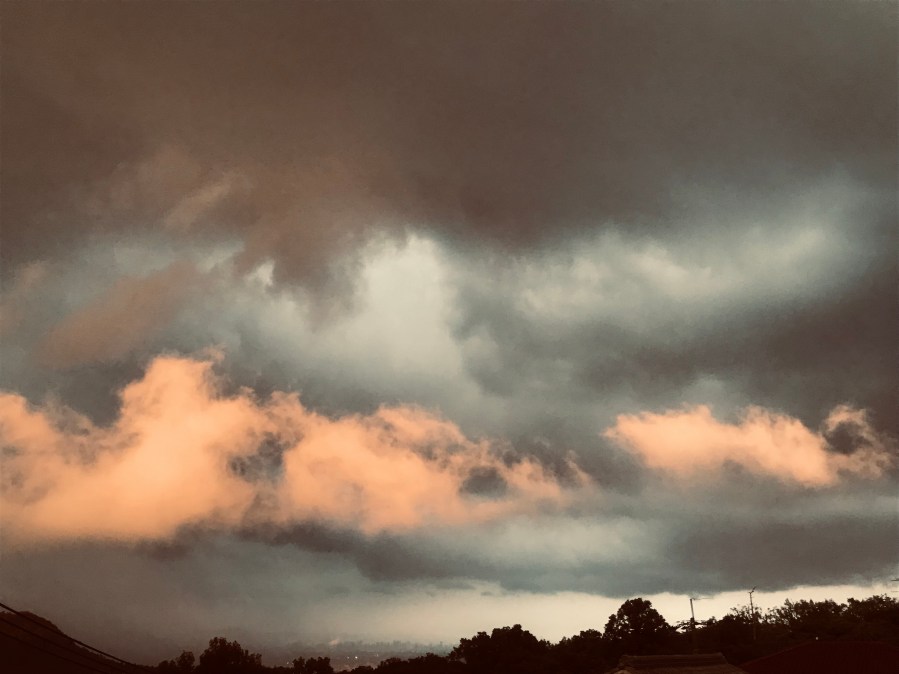
Or not? Like me, do you see a dragon in these clouds? If you don’t, does that mean that my dragon doesn’t exist despite my having seen it? Something in the clouds which you see is indeed seen by you, even if I can’t see it. Your perception is not dependent on my agreement. And likewise, my dragon doesn’t need to exist in your mind for it to exist in mine. So what is the reality of perception?
“Pareidolia” is the perception of recognizable things and/or patterns in random visual data. Seeing a rabbit on the moon (Japan), a face in a few lines and dots :- ) or faces in the clouds, are examples of common shared pareidolia. If it is not shared or collective, does that make it less real? Even the words which you read here are a system of agreed upon meaning imposed upon abstract form, but are not necessarily any more “real” in of themselves, than my dragon in the clouds.
In an article from Psyche digital magazine, a team of neuroscientists investigate the link between pareidolia and creativity, and by extension, the nature of perception and consciousness itself. They ask the questions, “Is all of perception an illusion? … How can we distinguish a complete illusion, or delusion, from a useful creative interpretation?” Does usefulness correlate with the degree to which the pareidolia or said perception is shared? Is meaning a matter of collectiveness and community, whereas delusion is a form of isolation?
For example, every Japanese person can see a rabbit on the moon pounding mochi (rice cake), and mochi-pounding events are part of traditional autumn festivities related to celebrating the harvest moon. Thus, the collective pareidolia has had significant meaning and usefulness to an entire culture of people for millennia. Furthermore, a Japanese person who claimed to be unable to see a rabbit on the moon pounding mochi, I dare say, would be perceived as delusional in Japan.
But does that mean there actually are rabbits on the moon—pounding mochi? Does it matter?
Buddhism and the sages of India have long declared that everything is maya, or illusion. A notion similarly and somewhat humorously expressed in “western” terms by British psychologist Richard Gregory: “It seems to be profoundly true that all perceptions are loosely controlled hallucinations.”
Perhaps reality is not a matter of collective versus individual perception. And if not perception itself nor the thing in of itself, like Gertude Stein’s a rose is a rose is a rose, then what is it? Is it the cloud or the dragon, both or neither? After all, both cloud and dragon do not exist outside the realm of my experiential perception.
Could it be that reality is essentially a matter of belief? And that when it comes to understanding the world in which we live, the heart is a more powerful instrument of perception than the brain? Afterall, if I don’t believe in my dragon in the clouds, how can he bring me gifts of rainbows and messages from the gods? Perhaps reality—the world and our experience of it—is simply a poem in the making… nothing more or less than a beautiful song or a delicate dance… an ongoing creative work of art.
What is your art? and the nature of your craft?



 Michiru Adrienne