The Ocean

One of the loveliest things about strolling along the beach is finding seashells. Some of them call out to you, with a little coy glimmer or a slight beckoning and irresistible sigh. “Come, take me home with you, let me adorn your shelves, let me remind you of the sea and its beauty every day” they whisper. And others even more beguiling, “For you, I have made the arduous journey and stranded myself upon this shore! Do not leave here without me.” Alas, what heartless soul does not succumb to the romance of seashells?
Like seashells, poems too find their own ways of surfacing into our meandering minds and our wanderlust—just at the very precise moment we need them. Our wayfaring souls are steered by poetry and seashells alike.

Here is a poem by Khalil Gribran which articulates an inevitable journey to the sea, to the ocean of becoming. And on the eve of 2022, and of all the unknown ahead, I pause on its sandy shore and watch the waves rolling in. Shall I walk back now to the familiar comforts of my faraway motherland, or shall I plunge into this ocean, this unknowable depth with a million and one shades of blue—unabashed, without reserve, naked, and wholeheartedly?

Fear

It is said that before entering the sea
a river trembles with fear.

She looks back at the path she has traveled,
from the peaks of the mountains,
the long winding road crossing forests and villages.

And in front of her,
she sees an ocean so vast,
that to enter
there seems nothing more than to disappear forever.

But there is no other way.
The river can not go back.

Nobody can go back.
To go back is impossible in existence.

The river needs to take the risk
of entering the ocean
because only then will fear disappear,
because that’s where the river will know
it’s not about disappearing into the ocean,
but of becoming the ocean.

Khalil Gibran
again

~a short meditation on flight, five~

and into this house of the sun 
i am carried again
swept up
held, and
laid down in its luster
soft center churning gold
into golden
rims
burning and brimming full
fuller and fuller, thicker and
rounder, rounder rims
        we 
                p
                   l
                      u
                           n
                           
                                      g
                                             e
and we
                 d
                      i
                            v
                              e


and then we  f l  y    f o r    f o  r   e    v     e      r
in all
and in every
d    i    r    e    c    t    i    o    n


again

Querencia

onto my screen
"querencia" saunters
announcing herself fresh
like an ocean breeze
and like the lightest foam on this sea's shore
she is the trending word
she is trailing her footsteps all across
the social media sand dunes 
"querencia
querencia
querencia" 
i repeat after the computer-generated voice
google translated
"querencia"—its quick to softness 
melts in my mouth
i'm caught i like it and i succumb 
like butter to the sun
"Gotcha!" she laughs
with a wry wink and a wave
and saunters again, 
this time off 
towards some shimmering coral-pink horizon
beyond my screen

querencia~querencia~querencia*
my love 
my heart
untamed roses and
my diamond in the sky 

*a Spanish metaphysical concept on the place from which one's strength and/or inspiration is drawn; where one feels most authentic, safe, and at home

philocalist

philocalist: a person who loves beauty; one who sees and appreciates beauty in all things.

What is beauty? Like love, beauty is some kind of nameable uncontainable, some kind of innate and immediate and intrinsic nature of our humanness. And like love, beauty eludes definition the way sunlight escapes boxes and the shadows. We cannot live without the light. We cannot live without love and we cannot live without beauty.

Beauty might be a rose, or a stranger who comes to our rescue. It could be that smooth shiny surface of wooden floor boards worn step after step after step after step—a million times over. Or sparkles dancing on water. Dew in the morning light. A friendly smile. Honey. And sweetness.

In one way or the other, beauty is everything that is good. Like a natural point of rest, beauty is the default setting for our most essential selves. The Navajo word for it is Hózhó. Harmony balance reciprocity peace.

So in your moments of darkness, of hurt or of despair, look into the mirror and remember that not only are you beautiful—but that you are beauty itself… beauty reflecting beauty. Say not “I am beautiful”, but declare “I Am Beauty”. And everything else in this tumultuous life shall fall into place—step after step after step after step—you shall Walk in Beauty. Hózhó.

philocalist: a person who knows themself as beauty; one who walks in beauty.

into the light

t um blin g 
at the edge of the world 
i fall 
down 
tumbling with the awkward
grace 
of a dancer 
unhinged 
unfettered 
unbridled  
and entirely 
undone 
free 
free now 
and cascading freely
down and
over the edge and at last 
tumbling 
tumbling down 
t um blin g  
down 
and 
and into 
the  l  i   g    h      t
 

the poet’s day off

today i take refuge in the mundane
the ordinary and prosaic 
laundry beckons like an old friend
or, a cup of hot black coffee on my desk

for lunch, i eat goat cheese with sliced cucumber sprinkled with lots of black pepper and a dash of cayenne a drizzle of honey dried parsley flakes and chopped walnuts... between two slices of whole wheat bread, with a glass of tap water
really
you should try it

today, every single one of my electronic gadgets work without mishap while
crystals and sage bundles 
gather the dust
the vacuum cleaner is no dance partner today, nor
hungry ghost
and the gods are silent 
and clocks steer clear of double digit numbers

flowers are just pretty flowers, and 
rocks are, well.... rocks

i welcome the air, slightly matte and thick
like a fleece blanket somehow comforting in its stillness

today i take a shower, trim my nails—no polish—rub cream into my face and go to bed before the stroke of midnight, and do not dream
for just today
i am twinkled out, and grounded.

tomorrow, i shall fly
again

field of dreams

Life is a field
of dreams
growing with the wind
and weather patterns 
of thoughts
feelings 
and voices
Voices from the soil
of memory
past loves and sorrows
past joys and triumphs
and remorse 
They take root
and grow
into our field of dreams
And whether asleep or awake
we all walk our field of dreams
on pathways of hope 
or of despair
to horizons unknown
But surely
on a pathway of love
love itself is the horizon 
and the infinitely wild beautiful blue sky above
 

仲間 (nakama*)

between worlds i fly
with stars sun and moon dancing
my heart wide open

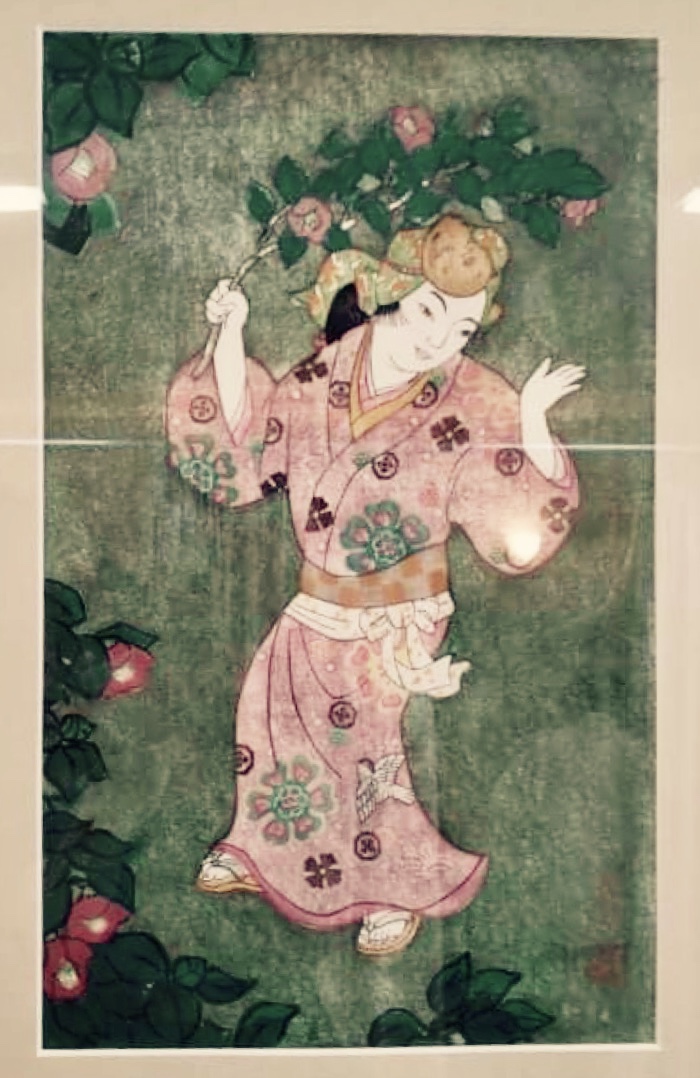
One of the precious things about friends is that they do little things for you which they know will mean a lot. The above photo is a painting of an ancient Japanese dancer holding a branch of tsubaki (camellia) flowers. To me, the painting expresses a unity of nature and dancer, freedom of movement within tradition and continuity, as well as love and sheer joy. Grace and surrender. Ecstasy. It is everything I’d wish to express myself, in my own dancing body. 

Knowing that I would love this painting, my friend who happened upon it by chance, took a photo and sent it to me. And for this alone, I will treasure our friendship forever. There are these threads which we do not see, and yet they are there nonetheless—somewhere and somehow, weaving together our gestures and our footsteps into criss-cross patterns in the unfathomable sky. 

We are dancing this mysterious journey, together, across seas of tumultuous unknowns… across space with no dimension and time with no border. Dancing, without destination nor particular goal. We dance, for love. For joy. We dance to dance the dance. 
It is a prayer in the dark; and sacred offering in the light. 
I will be there dancing, always. 
To dance for you. To dance with you. 
To dance the dance.
To dance.
Dancing.

*仲間 nakama means friends or partners in the same group, often those you have a long-term relationship with and shared experiences. This mini-essay was written for my traditional Japanese dance nakama, to whom I am infinitely grateful.

Gold

this love is gold light
in wild flowers and bold skies
beauty everywhere

(haiku 5-7-5)

The Holy Grail

Certain things are a matter of belief. 
Do you believe, for example, that the holy grail is real and that its location has or has not yet been discovered, or do you believe it is a striking creation of medieval European literature? If it is not actually real, why do so many claim to have found it? Why does something of such ambiguity hold such sway, spanning centuries and continents? 

Belief in certain things is a matter of contention. Is there life after death? God? Reincarnation? Telekinesis? Whereas belief in other things is rarely of dispute. Rain falls to the ground from clouds. The sun rises in the east and sets in the west. Kyoto city was the capital of Japan for over 1,000 years. 

So why is the existence of a god or gods or goddesses or holy people or deities or kami for that matter, at times hotly contested whereas the sun’s emergence in the east generally is not?

We might start by pointing to the tangible-to-the five-senses and thusly physically experiential nature of the sunrise in what we know to be “east”. However it is also true is it not, that many people, when asked where east is, will not be able to answer correctly on the spot without external reference to a map or mechanical compass of some sort. Physical experience alone is insufficient. To understand where east is, we must have somehow learned something about the relationship between the sun and earth, about planetary orbits, the solar system and space. But from the point of view of Pluto, or of a star in Andromeda, how fixed or relevant ultimately is Earth’s east, anyway? Is east to the left or to the right? Your left or my right? 

As for intangible-to-the-five-senses things such as kami, we might point to the ubiquity and continuity of shrines in Japan as evidence of their actual existence. “Believers” may claim to have experienced physically tangible results after praying to kami, such as healed illnesses or passed university entrance examinations. Visions of non-physical beings or other experiences beyond the tangible-to-the-five-senses might also be cited by some as proof that kami are real. Such “intangibles” however, are often disputed as imagination and thusly unacceptable and unverifiable evidence. But what are “visions” after all, if not something seen somehow?    

I am not here to profess what is true or not true. But I am here to question our assumptions about what we believe to be true or not true. And I am here to suggest that the holy grail itself is not necessarily its purported historical and physical reality, and that it is not necessarily a thing of literary legend—but that perhaps the real holy grail is realizing that what we believe to be true is “true”. Truth is a consequence of belief; not necessarily the other way around. What you believe creates what you experience; not necessarily the other way around.
Perhaps, in other words, the real holy grail is that we are all—each and every one of us—kami