no place to hide

LOVE  is light    which        like the  SUN            has no         place                                        to       hide.

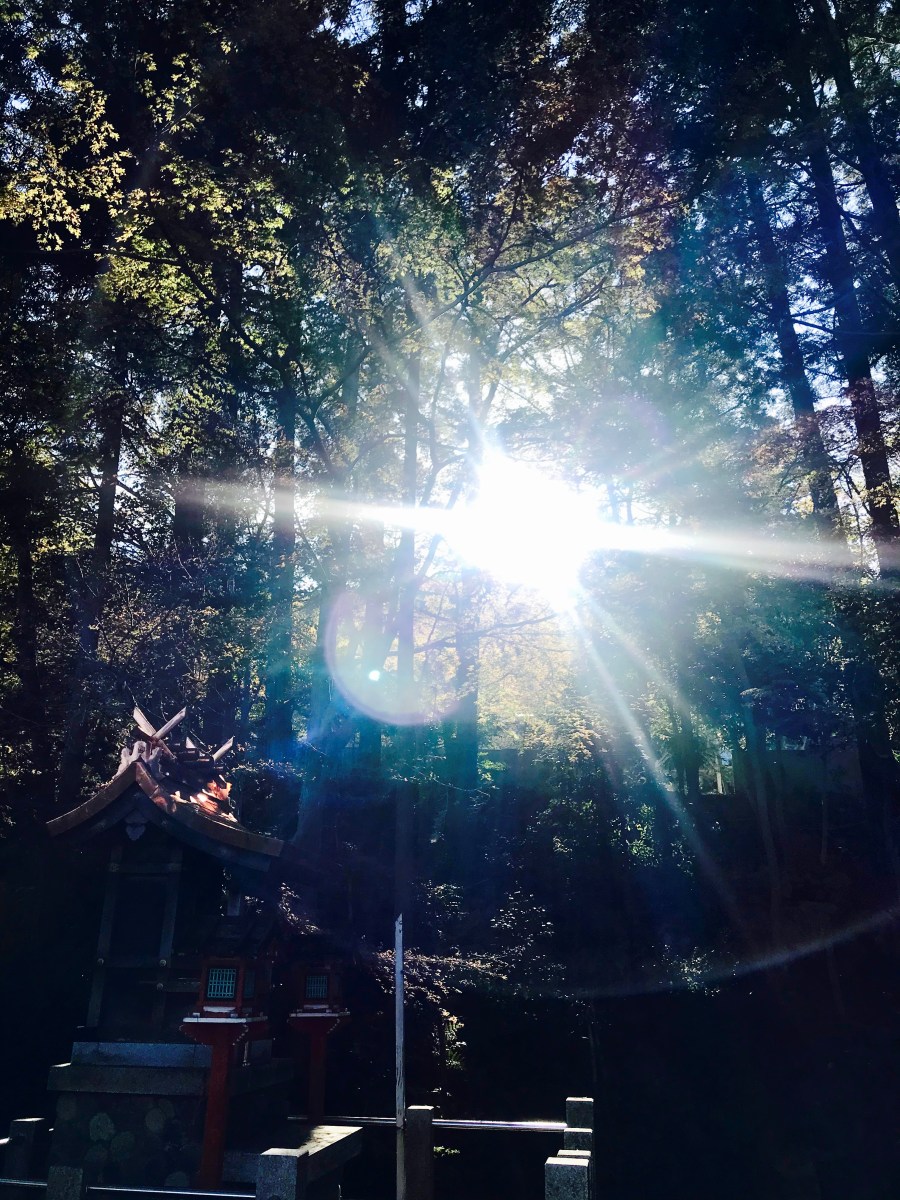
Once upon a very, very long time ago, the world was suddenly thrown into utter darkness and chaos. The notorious Susanoo, god of storms and the younger brother of the sun goddess Amaterasu-Omikami, wrecked havoc in the goddess’s rice fields and committed other acts of flagrant violence which so angered Amaterasu-Omikami that she hid herself inside a cave and barricaded the entrance with a boulder too heavy for anyone to move. She would not respond to any appeals to come out of the cave. 

Faced with this dire situation, all eight million deities of Japan convened in front of the cave and devised a plan to convince Amaterasu-Omikami to come out of hiding. A large mirror was placed in a tree just outside the cave’s entrance and another goddess, Ame-no-Uzume-no-mikoto, proceeded to dance atop an overturned bucket. Dancing with abandon and stamping upon the bucket,  Ame-no-Uzume-no-mikoto danced and danced and danced and then tore off her clothes all at once, causing the other deities to laugh uproariously. 

Hearing all the commotion from inside the cave, Amaterasu-Omikami could not contain her curiosity. What on earth could all the deities be laughing about in her absence? And so she opened the cave a tiny bit to peek out and saw her own brilliant reflection shining back at her in the mirror! Bedazzled just long enough, the strong god who had been patiently waiting there at the cave’s entrance then pushed the great boulder aside and pulled Amaterasu-Omikami out from the cave. A shimenawa, sacred rope, was placed in front of the cave, preventing the goddess from going back inside. 

And at last, light was restored to the world.

no place to hide

Do not hide your love, little one. 
Like the sun, be bedazzled by the brilliance 
of your own light, 
of your beauty,
and your love. 
Go ahead now, step out, 
boldly and brightly 
into every sky, Shining.
Dancing,
all naked, raw, and real.
For not a single day goes by, 
that does not need your light and
your love,
that does not need
you. 

sunrise in the land of the forgotten

On my path two white feathers nestled together like lovers—one bloodstained and the other not—give me pause. What unseen shadow is trying to come into light? Searching and searching and searching for something, weights seem to pull me down beneath busy surface waves, but my flashlight finds nothing to shine on. Like the great wall of China running beyond horizons east and west, the veil is endless and the sun refuses to rise, in this land of the forgotten. 

Like the dark side of the moon, mystery is for earthbound dwellers only. How might i drift to the other side? Might it be a perilous voyage, or pleasant? But shadows only exist in the light, disappearing as they do, into the darkness. How to find them there? Futile, is it not? Chasing shadows in the dark!

It seems i must, rather, coax them into the light. Not into the full glare of noontime, but into the gentle and warm glow at dusk—the between times in which worlds come together. Holding hands, light and dark dance together and shadows are set free to spin and to twirl without worry, without blame. 

Here, on this light red ribbon between earth and sky, the forgotten might surface softly into the welcoming arms of the soul. Into a love-lit world and shed its amnesia quietly into the sea.

But dreams crashed by despair, innocents violated, curses cast by exes, love gone astray and betrayed, bodies beaten and bloodied… these shadows are not light. Their exile into the land of the forgotten might often be the one thousand armed goddess of mercy shedding tears. Without release, without respite, they are like ominous clouds haunting the horizons, bound to erupt into fire storms and broken river banks.

ash

repressed memories 
explode
like stale fireworks past their expiration date
up into a void and blanked out space
the embers fall, slowly
drifting down
through this bitter smoke-filled sky
and choking, i shed my body
like skin in the aftermath of exposure
to flames
let the ash float
twinkle out and extinguish
in an ocean of darkness
and finally, i shall rest in peace
on a soft seabed of amnesia

The seabed is not so soft after all. Rocky, dark, cold, unforgiving, and lonely. Grave diggers will find no jewels here, no chest full of treasures. Where is my heart? It seems to have scattered somewhere—singed and scorched—in the smoke filled skies. 

Where is the way out? Where is that red lifeline, umbilical cord like, to the round curvature of mother earth? Can i surface from these depths and cry loudly into the pink light of dawn, my love and my light—memories intact? My heart, intact? And my soul, free?

Somewhere in the darkness i hear a heartbeat and a whisper: 
Look, look my love, over here.
The sun, all crimson for you,
ties this light red ribbon tenderly 
around your heart. 
Hold my hand and we’ll fly, 
spinning and twirling together now
up into the sun
dancing 
into a beautiful 
beautiful new 
day.

in touch with the world

When a poet brainstorms, writing somewhat stream of consciousness for an essay, it turns into an essay-poem or a poem-essay! What genre is this?! It is, a meditation on touch. 

in touch with the world 

touch, is the fundamental sense
the connective tissue between inner and outer worlds
bringing the faraway full moon into spectacular view
and the sweet sound of a loved one singing
straight into the heart
waves and particles crashing and colliding
connecting
childhood memories to the smell
of chocolate chip cookies baking, and 
fourth of July sparklers burning, bright

like the sea to coral reefs, or 
the sky to rainbows 
touch is the universe materialized 
made sensate and knowable, tangible 
to the heart and mind alike
to fingers, toes, and taste buds

the abyss
is touch deprivation
soundless, sightless, without taste or smell
senseless
love itself
an unknowable abstract intangible
void

in touch with the world
we are caressed by the flight of butterfly wings
the dance of sunlight
the soft fragrance of roses
the song of the ocean 
the sugar of honey

in touch with the world
our hearts are moved 
by kind words and thoughtful gestures
by the bravery and boldness
to connect
to other hearts

in touch with the world
with your hand on my heart
mine on yours
together 
we are healed

in touch with the world
together 
with one another
we discover our selves
beautiful
holy
 

Love & Light

Be like the flower, turn your face to the sun.

Kahlil gibran

We have sat for millennia, it seems, staring at walls into candle flames into the darkness and into the depths of our souls, in silence and solitude—seeking answers to resolve all of humanity’s imperfections, suffering, and ignorance… and for a way out of the dark. 
Perhaps moths are wiser, irresistibly drawn to the light, without second thought.

We have repented, confessed our sins, flagellated bare backs of ourselves and others, prostrated in front of superiors, and walked millions of miles on broken feet and bleeding knees. We have beaten, stoned, shot, mutilated and murdered—in the name of some greater light. 
Perhaps the flowers know better, naturally unfurling to the sun, without thought.

Perhaps life need not be so burdened, after all. 

Maybe we are in essence, simply beings of light and of love. We will realize our true nature, like the flowers, when we turn to the light; when like moths, our hearts burn with love, without thought. Maybe freedom is a bird in flight—on the wings of love and light. And divinity itself shines everywhere and in everything, omniscient and omnipresent. 

Perhaps, after all, we are simply divine beings of love and light. 

Go ahead—smell the roses and dance in the rain. Do it now—without thought, and for no reason. Shine.

dancing for the dead

Dancing for the dead is not macabre.
Dancing for the dead, we celebrate continuity, community, and life itself. 

In Japan, Obon is a traditional celebration in which the ancestors are remembered and honored. Family altars are cleaned and special offerings are placed in front of photos of the departed. Those living in far away cities return to their hometowns and to their families. Indeed, it is said that our ancestors too, return to our homes during Obon. For the living, there are gatherings at local festivals with music, folk dances, and stalls selling food and games. Bon-odori, folk dances performed during Obon, are usually done in a circle and the movements are simple and repetitive so that everyone can enjoy dancing together. In the commemoration of “the dead”, we join together as a community and culture—vibrant and sustained.

The stars do not cease to exist during the day simply because we cannot see them. Likewise, the souls of those who have come before us do not suddenly cease to exist at the end of their days. Rather, death is like night—a passage of time between skies full of light. And like the stars, our ancestors dance among us.

do not be afraid

do not be afraid
in the quiet blanket of nighttime 
do not be afraid
dreams come alive and 
love shines in candlelit cascades of whispers 
and caresses
it is darkness which makes the stars visible
guiding us home 
unveiled and holy
do not be afraid
to cross deserts windswept wildflower fields seas and 
mountain rains
the open blue of day welcomes you
warm outstretched and
just around golden pink corners

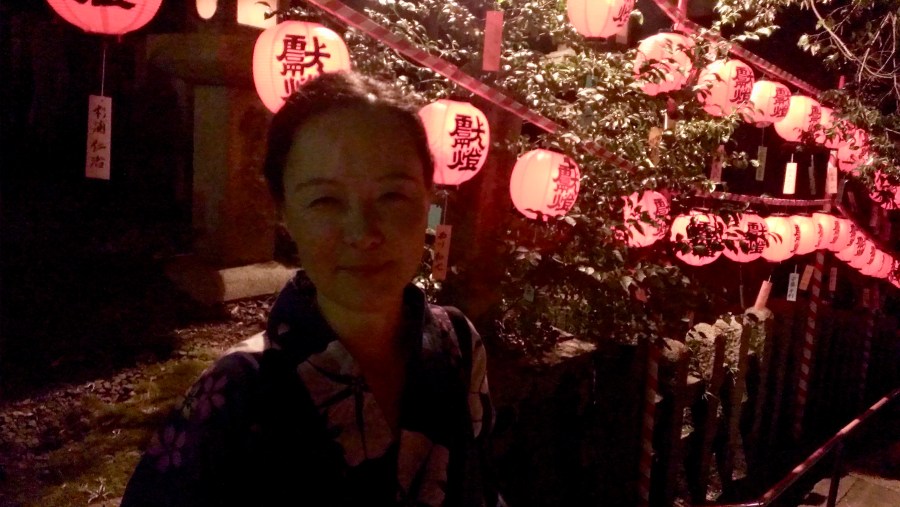
(photo taken six years ago at an Obon festival)

may peace prevail

After atrocity, the only thing that makes any sense is peace. Survivors of the August 6, 1945 nuclear bombing of Hiroshima have spent their lives dedicated to the abolishment of nuclear weapons, to educating succeeding generations about the horrors of war, to peace movements around the world. We do not hear of survivors from Hiroshima and Nagasaki (August 9, 1945) advocating a retaliation against the U.S. “Never Again” is the widespread mantra among survivors of atrocities worldwide: the Holocaust, the Rwandan genocide, the Nanjing massacre, to name a few. 

Likewise, on a more individual level, the expression, “I wouldn’t wish that on my worst enemy” is used by those who have endured some form of extreme pain or hardship. It could be surviving an excruciating illness or a traumatic act of violence. Having experienced something so painful, the natural human response is compassion. I wouldn’t wish that on my worst enemy. We don’t go about scheming how to inflict similar suffering upon others simply because we’ve suffered ourselves. On the contrary, we seek to prevent similar experiences of suffering. Mothers Against Drunk Driving, March For Our Lives, Missing and Murdered Indigenous Women, to name a few. 

The only thing that makes any sense, is peace. 

Many women, and #MeToo, have survived some form of domestic violence. Over my dead body, would I wish anyone the same experience—including the very man who committed the violence, including any perpetrator of violence, including, everyone. It never occurred to me to try to make the one who assaulted me suffer in some way. To respect my boundaries, my choices, my freedom—yes, to be held accountable—yes; but to inflict harm upon him—never. It simply is not worth it. What we do to others, we do to ourselves. 

The only thing that makes sense is peace. 

So what propels some of us to commit acts of violence? The answer ultimately is fear—its irrationality and ignorance. No wise sage ever, said, “Let’s bomb the @#¥%&! out of those weird people!” 

For comfort, fear seeks control; for control, fear hordes power. The power and brilliance of the sun, hijacked and desecrated, by the hands of men gone mad. In a single blinding flash at 8:15 a.m. on August 6, 1945, a fifteen meter per second firestorm in the thousands of degrees celsius ripped through Hiroshima incinerating some one hundred and forty thousand lives. Three days later on August 9, at 11:02 a.m., repeat.
Why? Why, why… why… how…..   

After atrocity, the only thing that makes any sense is peace.

Americans were scared of the “Japs”, and the Japanese were scared of the “foriegn devils”. In wartime, humans cease to be humane, seeing in one another only danger, forces of evil, and one’s own demise. Fear raises its monstrous head and slaughters everyone—indiscriminately. Everyone, every single one of us. 

My American grandfather, in WWII frenzy, derided those Japs, his future family and his own descendants—his cute granddaughters who giggled in delight when sitting in his chair anticipating being lifted out by their doting grandfather who never tired of playing the same game.

Children, in their innocence, are wiser.

ONE

Look into my eyes,
and you will see a shadow of Hiroshima.
You will see a dark room, illuminated by its single stream of
WHITE light
flowing from the humming projector as it reels GREY, WHITE, BLACK 
images onto a screen.
You will see ten silent rows of seated people,
formless figures in the darkness.
And you will hear the rusty recording,
as it comments on BLACK, WHITE, GREY
images thrown onto the cold square screen:

Atomic bomb “Little Boy” explodes at 8:15 a.m. August 6, 1945… Epicenter reaches several million degrees centigrade… ground temperature reaches 3,000 – 4,000 degrees centigrade… thirteen square kilometers completely destroyed… three hour firestorm with velocity of 15 meters per second… over one hundred and forty thousand deaths caused by “Little Boy”… 
(etcetera, etcetera, etcetera) 

b u t
the ears of a small girl have forgotten sound
listening only to naked terror run over the screen
h e l l 
Her eyes stare wide open in innocence tainted with blood, 
as the screen throws daggers into her eyes. 
Daggers of broken, burnt and twisted bodies lay strewn across an old wooden floor.

LOOK! 

s i l e n c e

Pale white light reflects from the screen
softly illuminates her tired eyes, her confusion, her small clenched fists. 
She tries with one fist, to grasp that “Little Boy” that Daddy’s country dropped, and she tries with the other fist, to grasp that firestorm that burned in Mommy’s country.
But a life of six short years knew only how to reach 
One hand to hold her mother’s
One hand to hold her father’s.

After atrocity, the only thing that makes any sense is peace.
The only thing that ever makes any sense, is peace.

Reclaim your innocence, like my grandfather did. 
Chose love. 
Be peace. 
Peace, is a verb.
Peace.

May peace prevail on earth.
May peace prevail.
hope

purified, clear light
everywhere in darkness shines
music for the deaf
vision for eyes wanting sight
and for my heart, the road home
(waka poem: 5-7-5-7-7)

What is hope, other than a beacon of clear light in the darkness? Wind behind sails crossing unknown seas. The moon in a sky of desolation. And, a heartbeat in the chamber of silence and stillness.

When we struggle, when we fall and despair, are utterly broken and feel lost, hope is the very thing that sees us through. 

How does hope come to you—in your darkness? What is your moon, and from where do the winds blow? What sound causes your heart to beat?

Even if we cannot see it, hope is that eternally rising sun on the eastern horizon—bringing with it, daylight into the night. Whether we like it or not, are ready or not, whether we open our eyes—or not… hope rises, again and again. For sometimes there is a certain comfort in the blanket of darkness, in being unseen and seeing not. We would rather evade, than wake up to our own hearts’ desires and truth. 

But hope, in its benevolence and persistence, will inevitably pierce that shell of illusive security and cast all shadows into the light. So go ahead already—shine. It is your birthright, and your destiny.

禊 Purification

Since ancient times, summer has been the season for purification in Japan. And according to the 79th Grand Master of Yamakage Shinto, Motohisa Yamakage, the earliest forms of ceremonial purification, or misogi 禊, most likely took place in the ocean—particularly where the river flowed into the sea. The two waters, conceived as masculine and feminine, symbolize in their merging, creation and rebirth. In this way, we can see that purification is intimately linked with the union of the feminine and the masculine, and the ensuing worlds of creation and growth.

Like death in the cycle of life, misogi is essential to the act of creation, and to growth. The goal of misogi is to cultivate a balanced self (body, mind, heart, spirit) that is pure and bright. This may be similar to some meditation and spiritual practices that speak of “raising one’s vibration” so as to merge with expanded levels of consciousness. However, misogi is not simply a mental exercise, it is embodied practice which resonates into every aspect of being and life.  

Misogi is the central tenet of Japanese Shinto, the indigenous, nature-based spiritual culture predating Buddhism in Japan. As such, misogi expresses itself in a myriad of ways both sacred and secular, in the daily life of contemporary Japan. At the entrance of every Shinto shrine, you will find a place to rinse your hands and mouth before entering. The physical act of cleaning one’s body is a ritual act of purification of the heart, mind, and spirit as well. Before entering a home, one removes one’s shoes at the door to prevent tracking in dirt from the outside. Japanese school children help clean their school buildings every day, and one often sees the elderly sweeping the streets outside their homes. Maintaining physical cleanliness is an all-pervasive feature of Japanese culture. It is the outer manifestation of an inner pure and bright self. 

In summer, we often long to go to the sea—as a place to rest and recuperate, to have fun and play, to release stress and to heal. We instinctively feel the purifying and healing energy in the salty air and water. It is a kind of home-coming to our ancient selves, birthed eons ago in those same waters. Reunited, refreshed, and replenished, we experience renewal. Rebirth. We can go forth, at peace with our selves and at peace with the worlds around us. We can be, a pure and bright light. 

"purification"

can i collapse
avalanche-like
into light
into wild windswept skies
and fly,
finally?

every shard of my sweet self
crumbled
and dissolved 
refined white sugar-like
into crystalline waters
transparent 
and pure,
holy

flowing and flowing
flowing finally,
to
into the open arms of 
my sea

on song

Everything is alive and has its own song.
Do you not see, hear, and feel, the song of the sea? Of the seagulls, the sun, and of the cirrus clouds as they fly through the sky? All singing together in a symphony of light, wind, waves… and love. Yes, love—especially love. If not for love, for what do we actually live? For what do we sing? Love is our raison d’être, ikigai, entire purpose. We are love itself and we sing to know ourselves.

Following is an excerpt from Kahlil Gibran’s The Prophet:

On Love
And think not you can direct the course of love, for love, if it finds you worthy, directs your course.
Love has no other desire but to fulfil itself.
But if you love and must needs have desires, let these be your desires:
To melt and be like a running brook that sings its melody to the night. 
To know the pain of too much tenderness. 
To be wounded by your own understanding of love;
And to bleed willingly and joyfully.
To wake at dawn with a winged heart and give thanks for another day of loving;
To rest at the noon hour and meditate love's ecstasy; 
To return home at eventide with gratitude; 
And then to sleep with a prayer for the beloved in your heart and a song of praise upon your lips.

If this understanding of love remains elusive, seek it out. I promise, it is worth everything that you have ever had, that you have now, and that you will ever have. And if you wonder where to start or to seek, remember this always: You are love💛

Star Festival

The seventh night of the seventh month (July 7) is Tanabata, or the “Star Festival” in Japan. This festival originates with an ancient story imported from China in the eighth century. According to legend, the two lovers Orihime and Hikoboshi, represented by stars Altair and Vega, are separated by the Milky Way and can only meet once a year. 

Orihime, once a hardworking weaver, and Hikoboshi, once a hardworking cowherd, neglected their work altogether after falling in love and getting married. This so angered Orihime’s father that he banished them to separate sides of Amanogawa (Heaven’s River, the Milky Way) and forbade them to see one another. Distraught, Orihime pleaded with her father to let her be with her beloved husband again. Orihime’s father then allowed the two lovers to meet once a year on July 7. 

Thus July 7 came to symbolize the fulfillment of wishes, and nowadays during the Tanabata festival, people write their wishes on colorful strips of paper and hang them on bamboo branches. Wishes are usually written in prose, but there is also a tradition of writing them as poems. Following is my Tanabata poem-wish.

七夕・Star Festival

on the seventh of the seventh
i wish for a river raft
for my love and i to sail the starry skies
—not for a one night rendezvous
across a river three hundred and sixty four days wide—
rather i wish
each and every night be
a festival of dreams and of desires
dancing into light
and dawning
each and every new day